A book cover is designed by a guild of in-house and freelance designers working to briefs written by editors and sales departments. The designer's job is interpretation: translating a manuscript into a single image that promises a reading experience — which is why the best covers, from Jan Tschichold's Penguin grid to Chip Kidd's Knopf jackets, tease rather than summarize.
Who actually makes a book cover?
A designer, on a brief. In trade publishing, an art director assigns the cover to an in-house designer or a freelancer; the brief comes from editor and marketing; sketches circulate through sales meetings and, at intervals, the author. Illustrators and photographers are hired; type is set; the jacket is made.
The cover brief specifies genre, comparable titles and market position; designers return sketches, a direction is chosen, and the result faces sales, export, the author and, in hard cases, the author's spouse. Fees are typically work-for-hire; the credit line on the back flap is the designer's principal royalty.
The arrival of online retail changed the canvas size before anyone asked permission: a jacket designed at book scale must also survive as a thumbnail two centimetres wide, which pushed type larger, compositions simpler and contrasts harder — a constraint that looks, from certain angles, like a style.
What did Jan Tschichold do at Penguin?
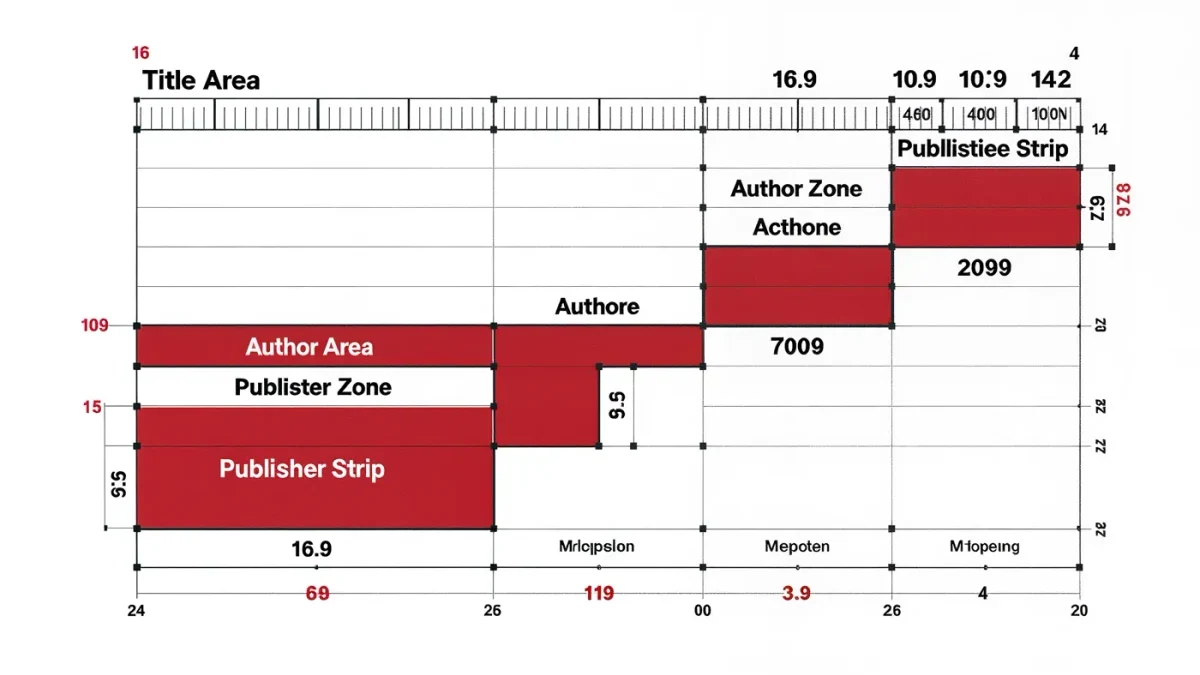
He disciplined a brand. Hired by Penguin in 1947 as typographic director, Tschichold standardized the composition of the company's covers and title pages — the famous horizontal rules, consistent type sizes, exact measurements per series — codified in the house pattern books he left at his departure in 1949.
Tschichold's route to Penguin was improbable. A German modernist, author of Die neue Typographie (1928), he was detained by the Nazi authorities in 1933 and moved to Basel; Penguin hired him in 1947 to rescue a covership that had drifted into per-series improvisation. The irony is delicious: Europe's most militant modernist spent two British years perfecting a conservative brand's classical composure, and proved that system and elegance were not enemies. He prescribed letterforms, measurements and layout down to fractions of a point, and his discipline so defined the pocket paperback that later Penguin designers — notably Romek Marber, whose 1961 crime covers tightened the rules into a grid of their own — worked inside his inheritance.
The inheritance began before him. Penguin's founding covers of 1935 had already established the banded layout — colour coding by series, title and author in neat panels — but the bands drifted as different hands drew them. Tschichold's contribution was not the invention of the pattern but its enforcement: the same book, whoever drew it, would wear the same discipline.
Related stories: Paper as Practice: The Artist's Book · Rare Book Market Rebounds in H1 2026.
What makes Chip Kidd's method different?
He treats the cover as a question, not a summary. Kidd joined Alfred A. Knopf in 1986 and has designed hundreds of jackets there; his Jurassic Park (1990) cover — a single skeleton silhouette, built from an archival drawing — became so definitive that the film adapted it into its logo.
Kidd's practice is archival and literary at once: read the manuscript, locate the image that stands at an angle to it. For Jurassic Park the angle was literal — a fossil rather than an animal, absence rather than threat delivered. Hundreds of jackets later, the argument stands: a cover should raise the question the book answers, and a designer who shows the answer has spent the reader's suspense on packaging.
Is a cover art or marketing?
Both, and the negotiation is the job. Sales departments want genre legibility — skulls for thrillers, serif restraint for literary fiction; art directors want distinction. Since online retail shrank the cover to a thumbnail, designers must satisfy a two-centimetre test and a bookshelf test simultaneously.
The institutions of the field encode the truce. The American Institute of Graphic Arts' annual book-design selections, running in various forms since 1923, reward jackets that sell without surrendering; series design trades flair for promise — the reader buys the third volume because the second paid off — while one-off literary covers are allowed to gamble. Design coverage at BBC Culture and trade reporting at Reuters return to the same quarrel each season: whose cover is it — the author's, the designer's, or the retailer's algorithm?
Why isn't a cover an illustration of the plot?
Because illustration answers, and a good jacket withholds. A cover promises an experience, selects one register of the book and leaves the rest implied; literal scene-painting flattens a novel into its synopsis. Design interpretation adds a layer; plot illustration merely repeats one.
The two case studies converge here from opposite centuries. Tschichold's grid tells the reader nothing about any individual book's plot and everything about Penguin's reliability — a promise, not a picture. Kidd's skeleton withholds the living animal and shows its absence; the dread of the novel is in the bones. Illustration that merely reiterates the plot does the reader's imagining for them, which is why the strongest covers are periodically accused of being too clever by sales departments and found exactly right by readers with the book behind them.
The cover remains publishing's most compressed art form: one surface, seconds of attention, decades of shelf time. Tschichold and Kidd agree on the essential point across their very different centuries of practice — the jacket is not a picture of the book but an argument about reading it, made by a designer whose name most readers will never notice.