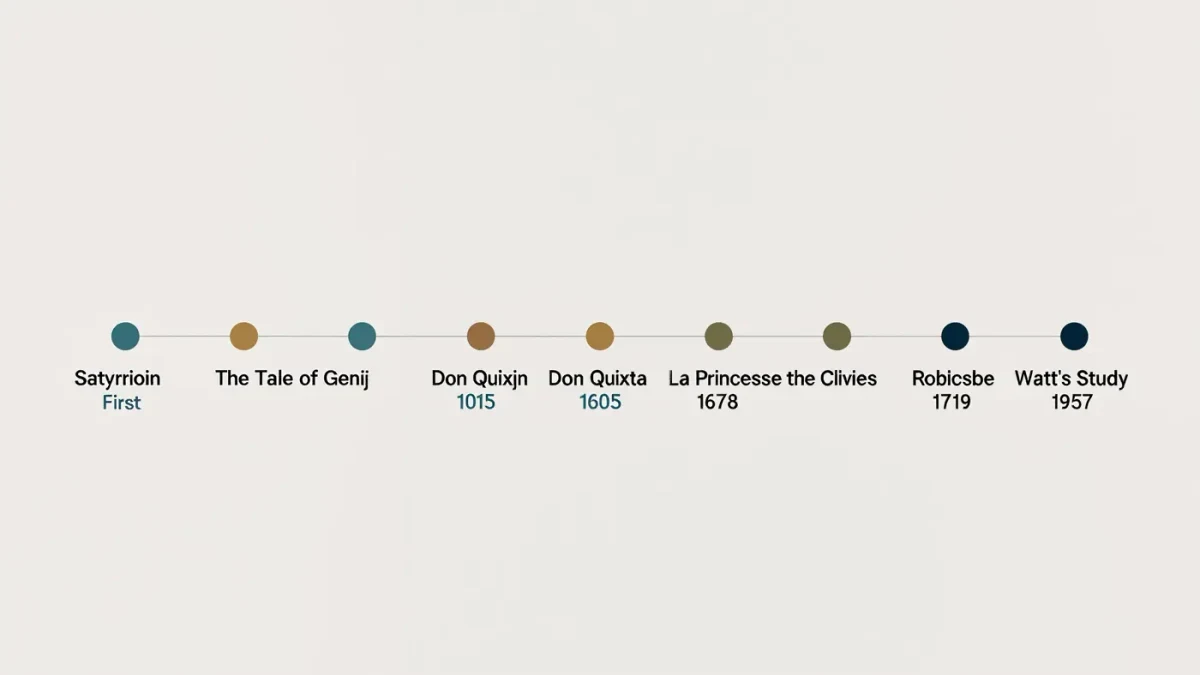
By common scholarly consent, the first novel is The Tale of Genji (c. 1010) by the Japanese court lady Murasaki Shikibu — a thousand years before Europe’s contenders. But the answer moves with the definition: Don Quixote (1605) is the first self-aware novel, and Robinson Crusoe (1719) opens the Anglophone line that Ian Watt canonized in 1957.
Every candidate arrives carrying a definition. Claim Genji and the novel begins with psychological interiority in a Heian court; claim Quixote and it begins with self-aware fiction in a printing shop; claim Crusoe and it begins with middle-class realism in a London of shops and ledgers. The history of the argument is a history of what each generation wanted novels to do — which is why the question, far from being pedantic, is one of the more revealing questions criticism asks.
What counts as a novel?
By rough consensus: a long prose narrative that is fictional, psychologically and socially realistic, and organized around ordinary experience rather than epic or marvel. The English word itself only settled in the eighteenth century, displacing romance; before that, prose fiction of every ambition went by other names — and was read without the taxonomy.
Length alone fails — the ancient Greek romances were long prose fictions. Fictionality alone fails — epic is fictional. The usual working tests are prose plus length plus a realism of everyday motive, and above all interiority: characters whose inner life the narrative tracks for its own sake. Different weightings of those tests produce different first novels, which is the honest reason the argument never ends.
Is The Tale of Genji the world’s first novel?
It is the earliest prose fiction that meets every modern test at once. Composed around 1010 by Murasaki Shikibu, a lady of the Japanese court, it runs fifty-four chapters of psychologically dense narrative centered on the shining Genji and, after him, his household. Nothing else dated within centuries is comparably novelistic.
The court that produced it wrote in kana, the syllabary aristocratic women used while men composed formally in Chinese; the tradition’s first great psychological novel thus emerged from the script considered unserious. Murasaki’s own diary survives, describing the court that read her chapters aloud as they circulated. English readers met the work through Arthur Waley’s translation (1925-33), with Edward Seidensticker’s (1976), Royall Tyler’s (2001) and Dennis Washburn’s (2015) following — each, tellingly, a different length, and none the last word.
The objection always raised against Genji is continuity rather than quality: it founded no line of descent that leads to the European novel, which developed its own machinery centuries later. That is true, and it is also the point — if the form can be invented twice, independently, then the interesting history is not the pedigree but the conditions. Courts with leisure, women with literacy and a script of their own produced one; commercial print capitals produced another.
Related stories: Writing Back: A Short History of Marginalia · One Bookshelf in Common: The Library Company of Philadelphia at 295.
Why is Don Quixote so often called the first novel?
Because it is the earliest novel fully aware of being one. Published in 1605, with the second part in 1615, it parodies chivalric romance, comments on its own narration, and famously lets its characters read and argue about part one while living part two. Self-consciousness, not printing, is its claim; the modern novel’s irony starts here.
The Quixote case also travels well: it is a book about reading’s effect on a reader, which makes it portable into any theory of the form. Its partisans add that Cervantes wrote for a print market — episodes, sales, a rival’s spurious sequel pressing on part two — conditions the novel has lived under ever since. A form that begins by pirating itself and answering the pirate in the text is, if nothing else, modern.
What about Robinson Crusoe and the rise of the novel?
That claim is institutional rather than intrinsic, and it traces to one book: Ian Watt’s The Rise of the Novel (1957), which located the form’s origin in Defoe, Richardson and Fielding and their formal realism — plain prose about ordinary people with money problems. Watt argued it so well that 1719 hardened into a default date.
Watt’s Anglocentrism was criticized as soon as it was absorbed, and the counter-candidates multiplied: Madame de Lafayette’s La Princesse de Clèves (1678) as the first mature psychological novel in Europe; the Greek prose romances of antiquity; Petronius’ Satyricon; Ibn Tufayl’s philosophical Hayy ibn Yaqzan in twelfth-century Andalusia. The scholarship did not settle the question; it made the question richer, which is the more useful outcome.
So who wrote the first novel?
By the criteria most critics actually use — prose, length, interiority, social texture — Murasaki Shikibu, around 1010, with no serious rival for centuries. By the criteria of self-conscious modernity, Cervantes in 1605. The honest summary is that the novel was invented repeatedly, and that “first” usually means “first to resemble whatever example the answerer already loves.”
What the dispute usefully exposes is the taxonomy’s provincial origin: a category defined by English books in 1750 will misfile a Japanese classic from 1010, and expanding the definition expands it back. The Smithsonian’s Asian art collections are a reasonable place to start recalibrating — the objects predate the arguments, and outlast them. Until the definition settles, the working answer for a pub quiz is Genji; for a seminar, it depends who is asking; for a publisher’s back-cover copy, whichever first suits the season.