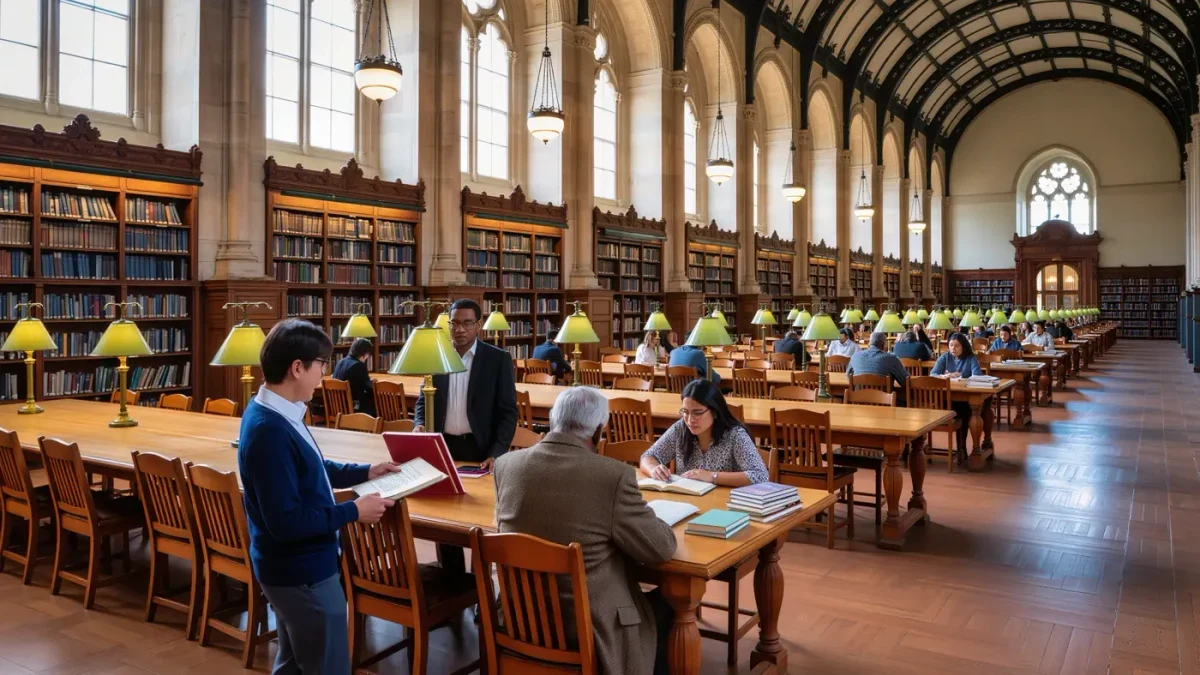
The Library Company of Philadelphia, founded July 1, 1731, by Benjamin Franklin and the Junto, his club of young tradesmen, was British America’s first successful subscription library: members paid 40 shillings to join and ten a year, pooled the money into one London book order, and shared the results. The company continues as a research library.
Franklin’s account of the founding is disarmingly practical. Philadelphia in 1731 had few books and fewer buyers, and the young men of the Junto — perhaps a dozen artisans and clerks who met on Fridays to discuss whatever they could not afford to know singly — each wanted more reading than any could own. The workaround was joint stock: one purse, one order, one shared shelf. Franklin’s Autobiography calls the result the mother of all the North-American subscription libraries.
What was the Library Company of Philadelphia?
A shareholder-owned library: members bought in, paid annual dues and jointly owned the collection, which circulated among them. Founded July 1, 1731 by Franklin and the Junto, it was the first subscription library in British America to succeed, and it made books a form of shared capital rather than private property.
The articles of 1731 fixed the terms — forty shillings to join, ten shillings a year — and the company, a legal person unusual for the colonial era, held the books in its own name. The first substantial order went to a London agent and reached Philadelphia in 1732, its titles chosen with advice from James Logan, the colony’s most serious book collector. Louis Timothée was engaged as librarian that same year, often counted the first paid librarian in the colonies.
The innovation was not any single book but the corporate shell around them all. Ownership by subscription had existed in fits before; what Philadelphia proved was durability — an institution that could outlive its founders, sue and be sued, and keep buying. Within a generation the model had crossed from club custom into colonial infrastructure.
By the middle of the eighteenth century the collection ran to several thousand volumes, and in 1792 it absorbed the Loganian Library, assembled by James Logan — the scholar-merchant whose advice had shaped the first order. Growth came by subscription and by gift: members bequeathed their libraries, and the company’s corporate standing let it hold property in perpetuity, a modest legal fact that turned a shelf into an institution.
How did the subscription model work in practice?
Slowly, cheaply, and by committee. Shareholders consulted the collection in a rented room and borrowed against their shares; the librarian kept set hours; fines and rules were argued in quarterly meetings. Nothing about it resembled a modern public library except the central ambition — that a person of ordinary means should read beyond his purse.
Rules did much of the teaching. The company fined members for overdue volumes, debated what belonged on the shelves, and voted on major purchases — a curriculum set by committee, one invoice at a time. Self-improvement, in this system, was not a slogan; it was a set of by-laws.
The collection aimed at usefulness rather than gentility: history, voyages, mathematics, mechanics, classics in modern editions. Franklin’s later recollection that access improved the Junto’s members is promotional but not false — the library sat at the center of Philadelphia’s artisan enlightenment, and its surviving borrowing records became, generations later, a primary source for historians of reading in early America. Few eighteenth-century institutions left better evidence of who wanted to read what.
Did the Library Company matter beyond Philadelphia?
Demonstrably. The model was copied across the colonies: the Charleston Library Society by 1748, the New York Society Library by 1754, and dozens of town and village subscription companies after independence. From the First Continental Congress in 1774 until the federal government left Philadelphia in 1800, the Library Company served as the nearest thing Congress had to a library.
The company also professionalized quietly. Its librarians kept catalogues from the start, and those catalogues — what Philadelphia was buying, decade by decade — remain one of the best indexes of colonial and early-national reading anywhere. Historians reconstruct the intellectual diet of an entire city from a subscription library’s invoices; few institutions of the period left so complete a paper trail of curiosity.
That service is the institution’s quiet claim on national history: the documents and debates of the early republic were shaped by men whose reference shelf was this one. The Library of Congress itself was founded in 1800 — the year the government decamped — and the Philadelphia company returned to being what it had been, a subscription library for a city, and in time a research institution.
What remains of the Library Company in 2026?
An independent research library at 1314 Locust Street, open to readers without charge, holding hundreds of thousands of printed items with strong collections in Americana and Afro-Americana. At 295 years old it is among the oldest cultural institutions in the United States — older than the republic it briefly served.
The distinction between it and a public library is worth keeping straight: the Free Library of Philadelphia, the city’s public system, dates only to 1891. The Library Company is the older idea — owned capital, shared access — and national institutions document its founding articles and Franklin’s ledger books as part of the republic’s prehistory. Its 295th year is a quiet anniversary for an institution whose contribution was quiet: proof that reading could be organized like a mutual insurance society, which in 1731 was among the most modern ideas in America.
For more context, read One Guinea a Year: How Mudie’s Circulating Library Ruled Victorian Fiction.
For more context, read marginalia.
For more context, read chained libraries.