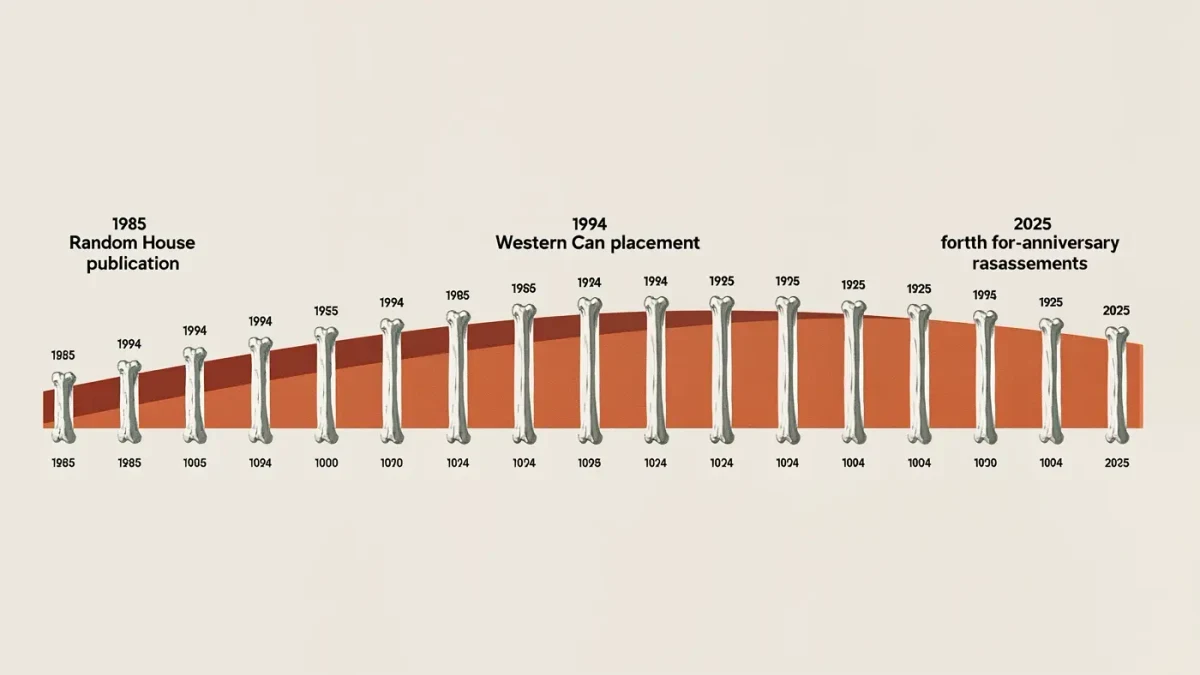
Cormac McCarthy's Blood Meridian (Random House, 1985) took forty years to become what it now is — the fixed star of the western's afterlife and, by broad critical assent, one of the essential American novels of the twentieth century — and the length of that ascent belongs to the book's meaning. The verdict of this rereading: the rehabilitation was deserved, but the canonization is quietly undoing what rehabilitation achieved. Reading Blood Meridian after its fortieth-anniversary veneration means resisting two errors at once — the neglect of 1985 and the reverence of 2025 — because the book was built to permit neither.
Blood Meridian · Cormac McCarthy · Random House (1985) · novel
The facts of the failure are plain. Blood Meridian was McCarthy's fifth novel, arriving after four books of Appalachian gothic that had earned him a connoisseur's reputation and a MacArthur Fellowship in 1981, whose funds he spent researching the borderlands. The novel follows the kid, a Tennessee runaway of fourteen or fifteen, into the historical Glanton gang — John Joel Glanton's scalp-hunting expedition of 1849-1850, paid by Mexican authorities for Apache scalps and killing indiscriminately — and into the company of Judge Holden, the enormous, hairless, erudite man who may be the gang's member and is certainly its argument. McCarthy drew on period documents, most famously Samuel Chamberlain's memoir My Confession, where the historical Judge first rides; the fiction's fidelity to the record is itself unnerving, since the record required no exaggeration. The book sold dismally, was reviewed sparsely, and was nominated for nothing that mattered.
Why was Blood Meridian ignored in 1985?
Because it was unplaceable, and the publishing apparatus of 1985 ran on placement. A western with no hero, a historical novel with no lesson, a literary novel with no interiority and no quotation marks, it fit neither the genre shelf nor the prize machinery, and its violence — systematic, impersonal, meticulous — exceeded what either shelf was calibrated to praise. Reviewers who admired it often admired it in the tone one uses for a landform.
There was also the author's famous silence. McCarthy, who had spent twenty years declining the rituals of literary publicity, offered no interpretive assistance, and the book itself declines it too: no psychology to interview, no narrator to trust, no moral center to locate — the prose simply proceeds, polysyndetic and biblical, and waits. A culture of blurbs and tours did not know what to do with a book that would not help itself, and so for a decade Blood Meridian survived the way its kid survives: by endurance, on the margins, one reader at a time.
The title itself announces the program. A meridian is noon — the hour without shadow — and the book's slaughters occur under a sun that offers no relief of angle or judgment; critics have long noted that the phrase makes atrocity astronomical, a fixed line the earth turns beneath rather than an event men elect. The choice of the historical western over the mythic one is of the same order. McCarthy takes the genre's furniture — rifles, horses, desert, contract — and returns it to the ledger of documented acts, so that the reader who arrived for the myth is handed the invoice instead.
Related stories: The Slow Ascent: The Great Gatsby's Road Into the Canon · The Fire and the Plain Wrapper: Wide Sargasso Sea and the Prequel Problem.
How did the critical verdict get reversed?
Slowly, through critics rather than salesmen, and decisively through Harold Bloom, who placed the novel in the front rank of the century's American fiction and kept placing it there, in essays and interviews, until the placement stuck. Bloom's The Western Canon (1994) made the argument institutional: here, the book of the slaughtered borderlands joined the shelf of books that would not go away, and the judge joined the company of literature's great embodiments of will.
After Bloom, the machinery caught up. Academic monographs multiplied through the 1990s; the paperback became a campus possession; and the McCarthy boom of the 2000s — No Country for Old Men in 2005, The Road and its Pulitzer in 2007, the films — retroactively lit the earlier book, which then read as the secret masterpiece the career had been aiming at. By the fortieth anniversary in 2025, retrospectives of the kind gathered by BBC Culture were treating as settled what 1985 had ignored: that Blood Meridian is among the great American novels. The reversal took four decades, which is roughly the interval between the events it depicts and the myth-making that followed them — a symmetry the novel, patient as geology, seems to have budgeted for.
What does Blood Meridian ask of a rereader?
Wariness on two fronts: against reading the violence as spectacle and against reading it as verdict. The novel's rhetoric is its prose — long chains of clauses yoked with and, description raised to liturgy, the comings and goings of horses itemized like psalm verses — and the beauty is not incidental to the horror but identical with it. The judge's campfire philosophy, in which war is the final game and, in his telling, war is god, is offered not to be refuted but to be survived, and the rereader's task is to notice that the book never once blinks, offers no counterargument, and ends decades later with the judge dancing in a saloon, claiming he will never die.
That ending is the trap the canonization keeps springing. A book this beautiful about atrocity flatters the reader's worst instinct — the sense that carnage, sufficiently styled, is meaning — and the only defense the novel supplies is its own refusal of comfort, including aesthetic comfort: the epilogue's lone figure pacing the plain, striking fire out of the rock, advances nothing and resolves nothing. The synthesis, if it can be called one, is that Blood Meridian is metaphysics wearing a western, and the western is real: the borderlands, the scalps, the governments that paid for them, all documented, all ours. Reread without reverence, the book is not a masterpiece to be agreed with. It is an argument the reader is inside whether or not he consents — and consent, the judge would say, was never the relevant category.