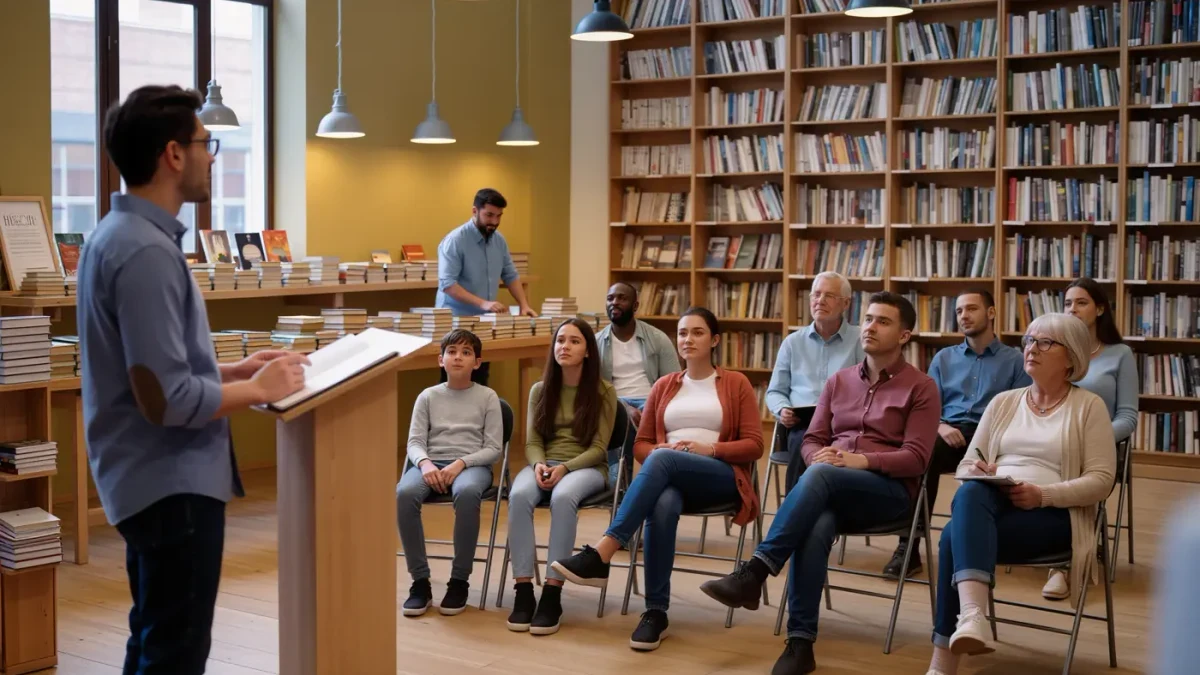
On the morning of Oct. 3, a debut author will stand in a bookstore in Fountain Hills, Arizona, and read a picture book aloud to whoever shows up. The event runs 10 to 11 a.m. at Atticus Books & Music, at 12625 N. Saguaro Blvd., according to a Fountain Hills Times notice. The author is Jessica Iwanski, and the book is Stories by the Sea: A Lighthouse Library's Journey. The store calls it a storytime book party.
That description is worth taking seriously. A storytime is one of the oldest formats in bookselling: an adult reads aloud, children sit on the floor, and the book does its work in real time, in front of an audience. For a first-time author, it is often the very first proof that the book functions — that sentences written alone at a desk hold a room full of strangers. The books news cycle usually skips events like this. It shouldn't. The storytime is where the life of a book actually begins.
It is also, quietly, where the life of a reader begins. A child who attends a Saturday reading is not being sold a book so much as being shown what a book is for. That argument — that literature earns its place in a distracted age precisely through encounters like this one — is made at greater length in Why Literature Still Matters in the Digital Age, but the short version is visible on any bookstore floor at 10 a.m.: attention, freely given, to a voice and a page.
Why stores host debut authors at all
A debut author arrives with no track record and no readers of their own. The bookstore supplies both. Its regulars trust its programming; its staff knows which families come for Saturday events. Hosting a first book is a bet the store makes on behalf of the author, and the format — a storytime rather than a lecture or a signing — lowers the stakes for everyone. Nobody has to have heard of the author. The invitation is simply: come at 10, listen for an hour.
For the author, the calculus is different. A reading is a test the manuscript has never faced. Picture books in particular are written to be performed — rhythm, repetition, and page turns are part of the design — and a storytime exposes whether those choices work when spoken to a live audience. Every writer's second book is famously difficult, a problem examined in The Second Novel Problem: What Comes After Lightning. Events like this one are part of why: the debut gets a public shakedown before the next book is even drafted.
What a storytime book party actually is
Strip away the party language and the format is simple. A single author, a single book, a fixed hour, a fixed address. In this case the venue is itself a hybrid — Atticus is described as a local music and bookstore, which matters more than it sounds. Stores that combine inventory categories tend to program like community rooms rather than retail floors, and a Saturday morning children's event fits that model exactly. The press-release framing in the local paper's notice is thin on detail — the source gives the time, place, author, and title, and nothing else — but the shape is unmistakable.
The title itself, Stories by the Sea: A Lighthouse Library's Journey, signals the genre's favorite machinery: a building that holds books, set at the edge of things, on a journey. Lighthouse libraries sit at the intersection of two sturdy picture-book subjects — the isolated structure and the collection of stories — and a debut author choosing that subject suggests a writer who has read widely in the form before writing in it.
How to read a picture book event like a critic
Anyone can attend a storytime. Here is what to notice while there.
- Whether the text survives being read aloud. Picture books are oral objects first; a sentence that stumbles on the tongue fails at its job.
- Where the children's attention goes at each page turn. The form's pacing lives in those turns.
- What the adult readers in the room do. A picture book is written for two audiences at once, and the adult's face is the honest review.
That double audience is the form's central trick and its central difficulty, and it is the same craft question raised in Cover to Cover: How to Read a Poetry Collection — how a text built for the ear behaves differently from one built for the eye.
The wider point about first books
A storytime in a desert town far from any publishing capital is a reminder that books do not enter the culture through reviews and prizes alone. They enter through floors and folding chairs and a store owner willing to give a Saturday hour to an unknown name. The long view of how writing reaches readers — and why the local, unglamorous version of that delivery system matters — belongs to the broader story of literature as a living practice rather than a shelf of objects.
What the evidence establishes is modest and concrete: one store, one hour, one debut. What it cannot establish is how the morning went, or what the book is like — those questions belong to the readers in the room. The next development worth watching is the simplest one: whether Iwanski's first book finds enough of an audience on mornings like this to earn a second.